You set up for a heavy deadlift, the bar leaves the floor, and somewhere around the third rep your fingers start peeling open like a stubborn jar lid. Your legs have plenty left. Your back is fine. But the bar is sliding, and you rack it before you wanted to. If that sounds like every set over 60kg you've ever attempted, your grip is the weak link in the chain, and it's quietly capping your progress on half the lifts you care about.
This is one of the most common bottlenecks I see in women who've been training seriously for a year or two. You build a strong posterior chain, your deadlift technique gets clean, and then your forearms refuse to keep up. The frustrating part is that grip is one of the easiest things to train, and most people fix it by accident the moment they stop relying on a workaround.
The straps trap nobody warns you about
Lifting straps are not cheating. Let's clear that up first, because women in particular get weird shame about using them, as if a real lifter does everything bare-handed. Strongwoman competitors use straps. Powerlifters use them in training. They let you load your back and hamstrings to the level they can actually handle without your hands failing first.
The problem is using them for everything. If you strap up on your very first warm-up set and never pull a single rep without them, your grip never gets the stimulus it needs to grow. You end up with a 100kg deadlift and hands that quit at 70. The fix isn't to throw the straps away. It's to use them strategically.
Pull your warm-ups and your first couple of working sets raw, then strap up for the heavy back-off sets where grip would genuinely limit the training effect on your hamstrings. That way your hands get loaded near their max every session, and your back still gets its volume. You're training both, instead of robbing one to pay the other.
The double-overhand problem
Here's where a lot of women lose grip strength without realising it. Once a deadlift gets heavy, a lot of lifters switch to a mixed grip, one hand over and one hand under, because it stops the bar rolling. It works. But it also means you stop genuinely gripping with both hands, and your raw grip stalls.
Train your double-overhand grip on purpose. Take your last warm-up set or a dedicated lighter top set and hold it double-overhand for as long as you can before the bar rolls out. This is essentially a heavy static hold, and it builds the kind of crushing strength that carries over to everything from pull-ups to carrying both bags of shopping up four flights in one trip.
Three things that actually move the needle
Forget squeezing a rubber ball at your desk. That builds endurance in a range nobody lifts in. If you want grip that shows up under a loaded barbell, you train it under load.
- Farmer's carries. Grab the two heaviest dumbbells you can hold, 20–32kg a hand is a good place to start working toward, and walk. Thirty to forty metres, three or four rounds. Nothing builds grip and full-body tension faster, and it doubles as conditioning that doesn't feel like cardio.
- Dead hangs. Hang from a pull-up bar for time. Start with whatever you've got, even fifteen seconds, and build toward a solid minute. This also decompresses your spine after a heavy session, which is a nice bonus on a hot June afternoon when you've been on your feet all day.
- Heavy double-overhand holds at the top of your deadlift sessions, as covered above. Among other carryover, these will quietly fix your pull-up grip too.
The chalk question
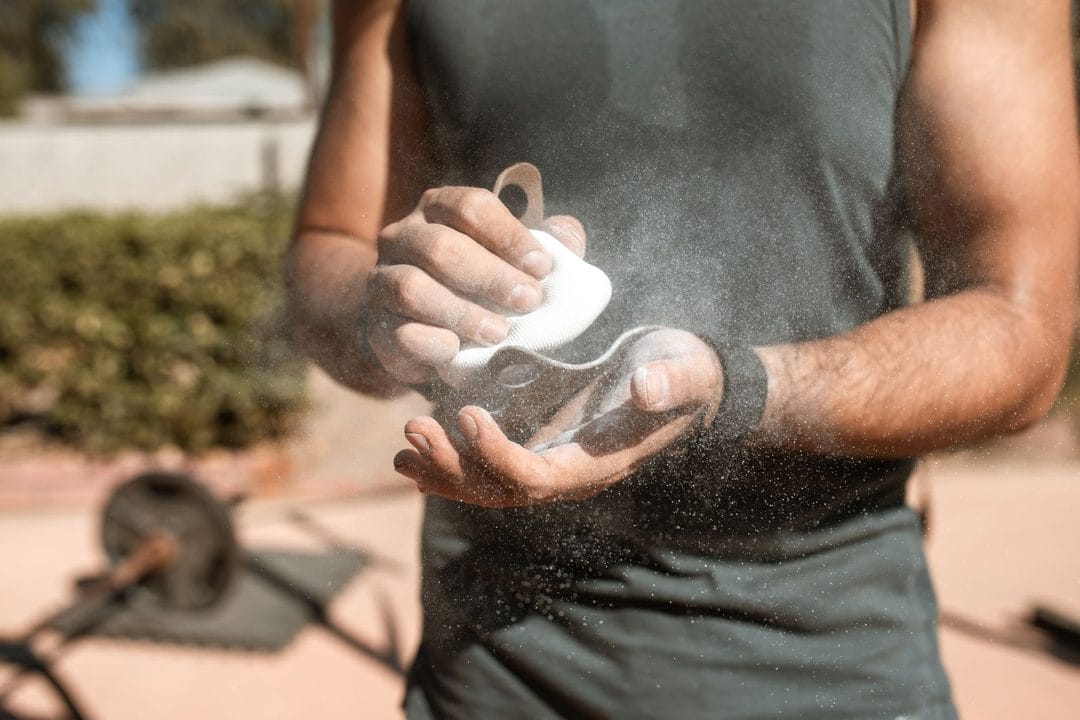
If your gym allows it, chalk is the single cheapest upgrade you can make. A block costs about £3 and lasts months. It soaks up the sweat that makes the bar slip, and in summer, when your hands are damp before you even touch the bar, it's the difference between a clean set and a frustrating one.
Liquid chalk is the polite version, and most commercial gyms that ban loose chalk are fine with it. A bottle from a brand like Gym Bunny or RDX runs around £8 and won't leave white handprints on everything you own. If your gym bans both, a rosin-based grip aid is the fallback, though honestly nothing beats actual chalk.
How long before it carries over
Grip responds fast, faster than most people expect. Add two focused grip sessions a week, carries on one day and dead hangs on another, and you'll usually feel the difference inside three to four weeks. The bar that used to slide out at rep three suddenly holds for the full set.
The bigger payoff is downstream. A stronger grip means you can finally load your rows and pulldowns properly, which builds the back that makes your deadlift heavier, which lets you carry heavier, and the whole thing compounds. It's rare for one small weak point to be holding back this much, but grip genuinely is that point for a lot of lifters.
One caveat: if your grip fails alongside numb or tingling fingers, that's not a strength problem, and no amount of farmer's carries will fix it. That's worth a conversation with a physio rather than another set of dead hangs. But plain old can't-hold-the-bar weakness? That's just untrained, and untrained is the easiest thing in the world to change.