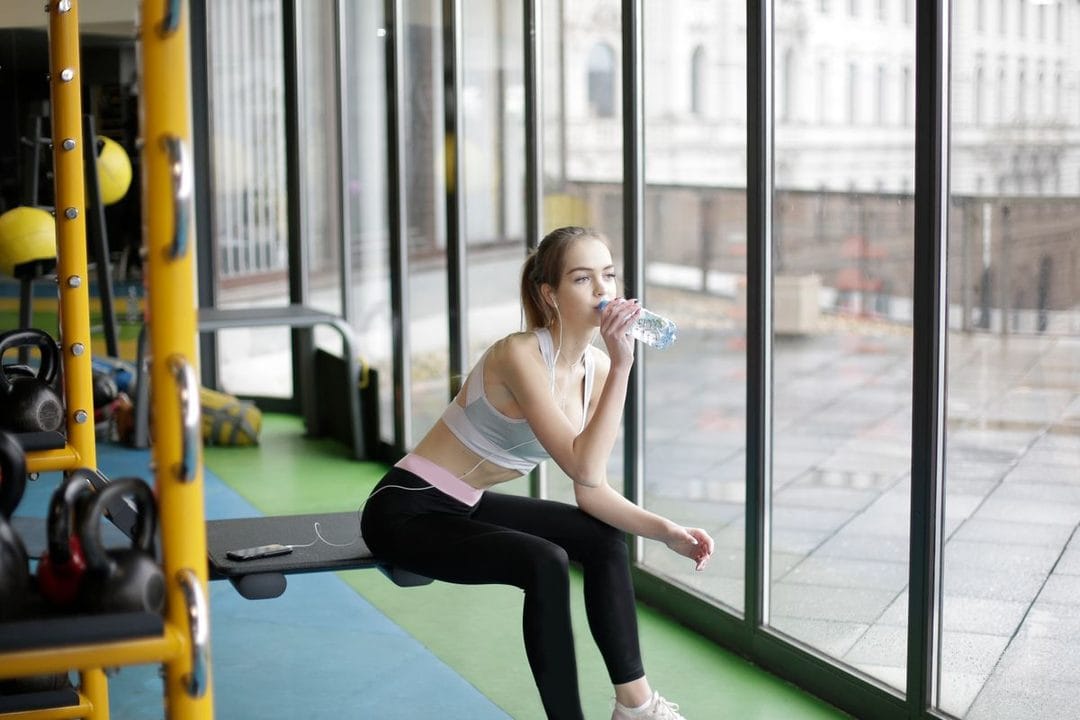
You finish a 50-minute strength session, towel off, and reach for water — plain, still, nothing added. Forty minutes later you've got a headache that won't quit and legs that feel like they belong to someone else, even though you drank more than usual. The instinct is to blame the workout. More often than not, the real explanation is what you didn't put back in your body, not what you took out of it during the session.
Most hydration advice aimed at women who lift or train hard still comes from two outdated places: the "eight glasses a day" rule that has no basis in exercise physiology, and endurance-sport guidance built almost entirely on male athletes running marathons. Neither one accounts for how much sweat sodium concentration varies from person to person, how the menstrual cycle shifts fluid balance week to week, or why overhydrating during a long, hot session is a documented risk in its own right — not just an inconvenience.
Why "drink eight glasses a day" doesn't apply to anyone training hard
The eight-glasses figure traces back to a 1945 US Food and Nutrition Board recommendation that was never meant to apply to exercise at all, and it ignores individual variation almost entirely. Sweat rate during a one-hour strength or conditioning session commonly ranges from 0.5 to 2 litres, depending on body size, heat, humidity, and training intensity — a spin class in a heated studio and a quiet dumbbell session in an air-conditioned gym are not remotely comparable, even if both last an hour. Layering a fixed daily water target on top of that kind of range produces advice that's either useless or actively wrong for most of the people reading it. What the research on athletic populations actually supports is drinking to replace measured losses, not hitting an arbitrary number picked decades before anyone studied sweat composition in a lab. That distinction matters more for women specifically, because average sweat rate tends to run lower than in men of similar training status, which means blanket "drink more" advice aimed at a mixed-sex population overshoots what most women's sessions actually require.
Sodium, not water, is usually the missing piece
Most women reading this have never once measured how much sodium they lose in a session.
Sweat sodium concentration varies enormously between individuals — lab measurements typically fall somewhere between 460 and 1,840 mg per litre of sweat, which means two women doing an identical circuit in the same room can lose sodium at rates nearly four times apart. That gap explains why one training partner can get away with plain water for ninety minutes while another starts cramping and feeling foggy well before the hour mark. Salt intake through food covers this for a lot of casual exercisers, but anyone training more than an hour in the heat, sweating heavily, or doing two sessions in a day is often running a deficit that plain water alone won't fix — water without sodium just gets excreted faster, which is the opposite of what you're trying to achieve. Skip the flavoured electrolyte tablets for anything under an hour in a temperature-controlled gym; plain water is the better choice there, and the cheaper one. Save the sodium-heavy drinks — a scoop of LMNT, a Nuun tablet, or a diluted Gatorade Endurance — for sessions that genuinely run long or hot: outdoor training in summer, two-a-days, or anything past ninety minutes where you're sweating through your kit.
How your cycle changes the equation
Plasma volume and thirst sensitivity shift across the menstrual cycle, and the luteal phase is where most of the noticeable change happens. Rising progesterone in the second half of the cycle nudges core temperature up by roughly 0.3–0.5°C and alters how the body regulates fluid retention, which is part of why some women feel puffier, thirstier, or more prone to headaches in the days before a period even without changing their training load at all. This isn't a reason to overhaul your hydration strategy every two weeks — but if you notice a pattern of feeling worse on identical sessions during the same cycle phase, that's a real physiological signal, not something to dismiss as being "in your head." Tracking sweat loss or subjective symptoms against cycle phase for a couple of months gives you far more useful information than any generic daily fluid target ever will.
Hyponatremia: the real risk of overhydrating during long sessions
The opposite failure mode gets far less attention than underhydration, and it's arguably more dangerous. Exercise-associated hyponatremia — dangerously low blood sodium from drinking more fluid than the body can process, without replacing sodium — has been documented in a meaningful minority of marathon and long-event finishers, and research on endurance races has repeatedly flagged smaller female runners drinking on a fixed schedule (a bottle every mile, say) rather than to thirst as a specific risk pattern. It isn't limited to elite ultra-runners, either; it can show up in anyone doing a long hike, an all-day hybrid event, or back-to-back outdoor sessions who drinks large volumes of plain water without any sodium alongside it. None of this means electrolyte drinks are unnecessary padding for serious training — they earn their place on the sessions described above. It does mean that "just drink more water" is bad advice for anything past the two-hour mark, and it's worth knowing the warning signs: nausea, confusion, and swelling that gets worse rather than better as a long session goes on, which is the opposite of what plain dehydration looks like.
A practical way to find your own numbers
You don't need a lab to get a reasonable estimate of your sweat rate. Weigh yourself (or skip clothing weight and estimate) immediately before and after a representative one-hour session, without drinking during that window if you can manage it safely, and the weight lost in kilograms roughly equals litres of sweat produced — a 0.6 kg drop means about 600 ml lost. Do this across a couple of different session types: a hot outdoor run, a heavy lifting day, a mixed conditioning class. From there, a few patterns tend to hold up well in practice, even though none of them replace paying attention to how your own body responds:
- Under an hour, moderate intensity, indoor and temperature-controlled: plain water, no electrolytes needed for most people.
- Over 90 minutes, or anything outdoors in heat above roughly 25°C, add 500–700 mg of sodium per litre of fluid — don't wait until you're cramping to start.
- Two sessions in one day, or heavy sweating you can see soaking through clothing, generally calls for salting food more deliberately at the next meal rather than only reaching for a supplement.
- If a session runs past two hours, plan sodium intake before you start sweating heavily, not after symptoms appear — by the time you feel it, you're already behind.
Salting food to taste covers a surprising amount of this for people training four or five times a week at moderate intensity, and it's considerably cheaper than a drawer full of electrolyte tablets that mostly go untouched.
What to actually drink, and when plain water is enough
Reading a label matters more than reaching for whatever's marketed as a "sports drink." Liquid I.V. and similar powdered mixes lean heavily on sugar for taste and carry relatively modest sodium per serving compared to something purpose-built like LMNT, which carries roughly 1,000 mg of sodium per stick — useful for a genuinely demanding session, overkill for a light recovery walk. Gatorade Endurance sits somewhere between the two, formulated with more sodium than the standard Gatorade Thirst Quencher specifically for longer, hotter efforts. For most strength-focused training under an hour, plain water plus a normally salted diet does the job completely, and spending money on electrolyte products for that kind of session is money spent solving a problem you don't have. The calculus changes the moment heat, duration, or sweat volume increases — at that point, sodium stops being optional and starts being the difference between finishing strong and finishing with a pounding headache and a training log entry you'll want to understand better next time.